Guttrz / Blog / 5-inch vs 6-inch gutters
5 inch vs 6 inch gutters: which size does your roof need?
How much more water 6-inch gutter carries, which roofs need it, and when larger downspouts are the cheaper fix.
A 6-inch K-style gutter carries roughly 40 percent more water than a 5-inch, and its 3x4-inch downspout moves roughly twice the water of a 2x3. Most houses do fine with 5-inch. Choose 6-inch for large or steep roof planes, long runs, metal roofs, and gutters below valleys. In Northeast Ohio, seamless aluminum is commonly quoted at about $8 to $14 per foot for 5-inch and about $10 to $18 for 6-inch, which are market ranges, not Guttrz prices.
The choice between 5 inch vs 6 inch gutters comes down to how much water your roof sends to the gutter and how fast. A 5-inch K-style gutter is the common size and it handles most houses. A 6-inch gutter carries roughly 40 percent more water and is the right call on large or steep roofs, long runs, metal roofs, and below valleys. This guide shows the capacity difference, which roofs need the bigger size, what Northeast Ohio storms deliver, and when larger downspouts alone solve the problem. Guttrz installs both sizes as seamless aluminum gutters, so there is no reason for us to push one over the other.
What is the difference between 5 inch vs 6 inch gutters?
A 6-inch K-style gutter is one inch wider across the top and deeper than a 5-inch, and it carries roughly 40 percent more water. It also pairs with a larger downspout: 3x4 inches in place of 2x3. Everything else, including the K-style shape and the aluminum, is the same.
| 5-inch K-style | 6-inch K-style | |
|---|---|---|
| Width across the top | About 5 inches | About 6 inches |
| Water capacity | The baseline | Roughly 40 percent more |
| Usual downspout | 2x3 inch | 3x4 inch, roughly twice the flow of a 2x3 |
| Best for | Most ranches, capes, and colonials with average roof planes | Large or steep roofs, long runs, metal roofs, valleys |
| Look from the street | What most houses already have | Slightly heavier line at the roof edge |
| Market price in Northeast Ohio, seamless aluminum installed | Commonly about $8 to $14 per foot | Commonly about $10 to $18 per foot |
| Leaf Solution gutter guards | Fits. $17 per foot single story, $19 two story or steep | Fits. Same rates |
The gutter prices in the table are market ranges commonly quoted in this area, not Guttrz prices. The guard rates are ours.
How much more water does a 6-inch gutter carry?
Roughly 40 percent more than a 5-inch gutter of the same length. One extra inch of width does not sound like much, but the trough is also deeper, so the cross-section grows in both directions. The bigger gain is often at the downspout: a 3x4-inch downspout moves roughly twice the water of a 2x3.
It helps to know how much water is involved. One inch of rain on 1,000 square feet of roof is about 623 gallons (1,000 sq ft x 1/12 ft of water x 7.48 gallons per cubic foot). An 800 square foot roof plane sheds about 499 gallons in a one-inch hour. All of it reaches one gutter, and often one downspout. In the worst few minutes of a thunderstorm the rate is several times higher than the hourly average, and that peak is what a gutter has to survive.
Do I need 6 inch gutters? Which roofs call for them
You likely need 6-inch gutters if a single gutter run collects water from a large roof plane, a steep roof, a metal roof, or a valley, or if the run is long with a downspout at only one end. If your 5-inch gutters are clean, sloped right, and still pour over the front in heavy rain, size is the suspect.
Large roof planes
The gutter does not care how big the house is. It cares how many square feet of roof drain to that one edge. A deep two-story colonial with a wide rear roof plane can send twice the water to its back gutter that a narrow ranch does. An upper roof that drains onto a lower roof adds its water to the lower gutter too.
Steep roofs
Water runs off a steep roof faster and hits the gutter harder. On a steep pitch it can shoot past the front lip of a 5-inch gutter in a downpour. The wider 6-inch trough gives it a bigger target. A steep roof also catches more wind-driven rain than its footprint suggests.
Long runs
Proper slope is about a quarter inch for every 10 feet toward the downspout, and a common guideline is one downspout for roughly every 30 to 40 feet of gutter. A 50-foot run with one downspout breaks that guideline. Everything from the far end has to travel the whole length, and the last 10 feet carries the water from all 50. Either add a downspout or go to 6-inch.
Metal roofs
Metal sheds water faster than shingles because there is no granule surface to slow it. It also sheds snow in sheets. A house in the Akron-Canton area sees about 47 inches of snow in an average season, and a sliding slab can hit a gutter hard. 6-inch gutter catches the faster water. Ask about hanger type and placement too, since that is what resists the snow load.
Valleys
A valley is where two roof planes meet and funnel their water into one stream. That stream lands on a foot or two of gutter at an inside corner. This is the most common spot for a clean gutter to overflow. A 6-inch gutter helps, and so does a downspout placed near the valley. Other causes that look the same from the ground are covered in why are my gutters overflowing.
How much rain do Northeast Ohio gutters have to handle?
NOAA's precipitation frequency data for the Akron-Canton airport area shows about 1 inch of rain in one hour happens about once a year on average, and about 1.75 inches in an hour about once every 10 years. Summer thunderstorms deliver most of those hours, and they do it in short, hard bursts.
Put that on the 800 square foot roof plane from above. The once-a-year hour sends about 499 gallons to one gutter. The once-in-10-years hour sends about 873 gallons (800 x 1.75 / 12 x 7.48). A 5-inch gutter with two clear 2x3 downspouts can usually take the first. Whether it takes the second depends on pitch, run length, and where the downspouts sit. That margin is what you buy with 6-inch.
Oversized gutters for heavy rain matter most where overflow does damage: above a front door, over a walkout basement, or along a foundation wall that already gets damp. The link between spilled roof water and basement moisture is explained in clogged gutters and wet basements.
2x3 vs 3x4 downspouts: when is upsizing only the downspouts enough?
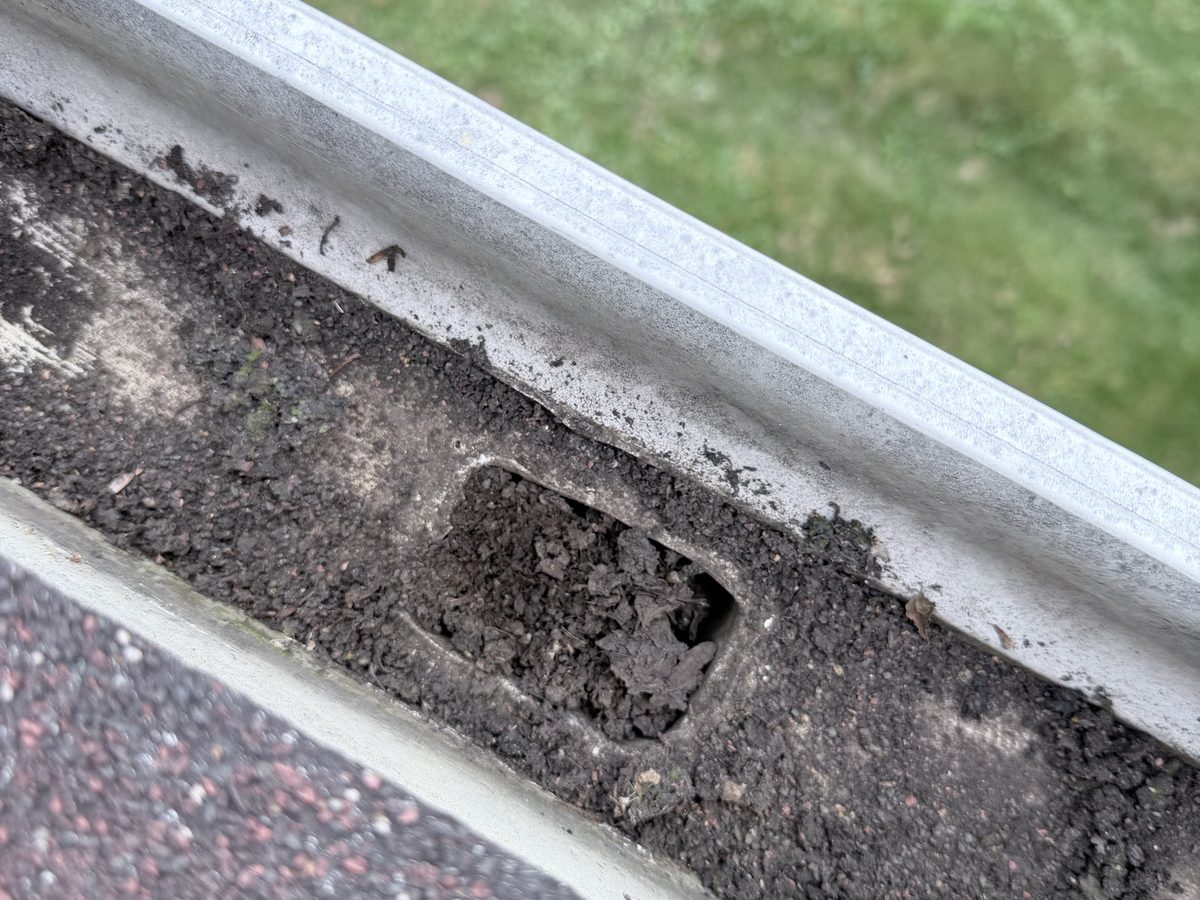
If water backs up and spills near the downspout end of a run while the rest of the gutter keeps up, the downspout is the bottleneck, not the gutter. Swapping 2x3 downspouts for 3x4, or adding a second downspout, often fixes that for far less than new gutters. A 3x4 moves roughly twice the water of a 2x3.
Bigger downspouts alone are enough when:
- The gutters are sound aluminum, straight, and sloped correctly.
- Overflow starts at the downspout end and works back along the run.
- The 2x3 downspouts clog often with maple seeds, oak leaves, or pine needles. The larger 3x4 opening passes debris that jams a 2x3.
- One long run has a single downspout and there is a good spot to add another.
Bigger downspouts are not enough when water overshoots the front lip in the middle of a run, when a valley overwhelms one corner, or when the gutters are worn out anyway. A larger outlet has to be cut into the gutter for a 3x4, which is a small job on sound metal. Guttrz replaces downspouts on their own, and reslope or rehang work falls under gutter repair. If you are unsure whether the old gutters are worth keeping, see repair or replace your gutters.
Check the simple things before buying anything. A gutter packed with debris overflows at any size. A gutter cleaning at $150 to $300 is the cheapest test there is: clean, flush the downspouts, then watch the next hard rain.
What do 6 inch gutters cost compared with 5 inch?
In Northeast Ohio, seamless aluminum gutters are commonly quoted at about $8 to $14 per foot installed for 5-inch and about $10 to $18 per foot for 6-inch. Those are market ranges, not Guttrz prices. On 180 feet the math looks like this:
- 5-inch: 180 x $8 = $1,440 at the low end, 180 x $14 = $2,520 at the high end.
- 6-inch: 180 x $10 = $1,800 at the low end, 180 x $18 = $3,240 at the high end.
Downspouts are usually a separate line, and 3x4 downspouts cost more than 2x3. You do not have to pick one size for the whole house. Many homes do well with 6-inch on the one or two runs that take the most water and 5-inch everywhere else, though some people prefer one size all around for a matching look. Guttrz does not publish a seamless gutter price yet. Your firm price comes in writing after a 20-minute on-site check and is good for one year. The full cost picture is in seamless gutter cost in Ohio.
Do gutter guards fit both 5-inch and 6-inch gutters?
Yes. The Leaf Solution gutter guard that Guttrz installs is made for both 5-inch and 6-inch gutters. The price is the same for either size: $17 per foot on single-story runs and $19 per foot on two-story or steep runs, corners included, with a $1,200 minimum. On 180 feet of single-story gutter that is 180 x $17 = $3,060.
Size and guards work together. A wider gutter gives fast water more mesh to land on, which helps on steep and metal roofs. Guards also keep downspouts from plugging, and a plugged downspout is what makes many right-sized gutters overflow. New gutters can get guards the same visit at the normal rate, with no cleaning needed. Rates and worked examples are on the gutter guard pricing page.
How do you tell what gutter size you have now?
Measure straight across the open top of the gutter, from the back edge against the house to the outer front lip. About 5 inches means a 5-inch gutter. About 6 inches means a 6-inch gutter. Do it from a ladder on firm, level ground, or reach a tape up from a first-floor window or porch roof edge only if you can do so safely.
You can also read the downspouts from the ground. Measure the front and side of one. About 2 by 3 inches almost always means 5-inch gutter. About 3 by 4 inches usually means 6-inch, though some 5-inch gutters have been upgraded to 3x4 downspouts. Older homes sometimes have 4-inch gutters or half-round gutters, and those are worth a closer look before any decision.
When is 6-inch gutter not worth it?
If your 5-inch gutters stay ahead of hard rain when they are clean, bigger gutters fix nothing. A small ranch with short runs and a downspout at each end rarely needs them. Neither does a low-slope roof with modest planes. Spend the money on a second downspout, on correct slope, or on keeping debris out. An honest on-site check should tell you which runs need the larger size and which do not.
To get your roof sized, use the form on this page or text your address to (330) 818-5584. The owner does a 20-minute on-site check with a ladder, measures each run and the roof above it, and gives you one firm written price for 5-inch, 6-inch, or a mix. Tear-off and haul-away of the old gutters and downspouts is included. Details are on the seamless gutter installation page and the steps are on how it works.
Common questions
Are 6 inch gutters worth the extra money?
They are worth it on runs that take more water than a 5-inch gutter can carry: below large or steep roof planes, metal roofs, valleys, and long runs with one downspout. On a small ranch with short runs they add cost without solving anything. The market price difference in Northeast Ohio is commonly about $2 to $4 per foot, so on 180 feet it is roughly $360 to $720 before downspouts.
Can you put 6 inch gutters on any house?
Almost always. A 6-inch gutter hangs on the same fascia board as a 5-inch, and the fascia on most homes is tall enough for it. The things to check are the condition of the fascia, the drip edge or shingle overhang above it, and whether the larger 3x4 downspouts have a clear path to the ground. Those are looked at during an on-site check.
Can I put 3x4 downspouts on 5 inch gutters?
Yes. A 3x4-inch outlet fits in the bottom of a 5-inch K-style gutter, and it is a common upgrade. A 3x4 downspout moves roughly twice the water of a 2x3 and passes leaves and seed clumps that would jam the smaller size. If overflow starts at the downspout end of a run, this is often the fix.
Do 6 inch gutters look too big on a house?
On most two-story homes and larger ranches the difference is hard to spot from the street. It is one extra inch at the roof edge. On a small cottage or a house with narrow fascia it can look heavier. Mixing sizes is fine functionally, but some owners prefer one size on the sides people see.
What size gutters do most houses have?
Most houses have 5-inch K-style gutters with 2x3-inch downspouts. That has been the standard residential size for decades. 6-inch K-style with 3x4-inch downspouts is the common step up for larger roofs. To check yours, measure across the open top of the gutter: about 5 inches or about 6 inches.
Will bigger gutters stop overflow in heavy rain?
Only if size is the cause. Clogged gutters, plugged downspouts, lost slope, and loose hangers all cause overflow that a bigger gutter would not fix. Clean the gutters and flush the downspouts first. If they still spill in a hard rain, 6-inch gutter, larger downspouts, or an added downspout is the next step.
Does Guttrz install both 5-inch and 6-inch seamless gutters?
Yes. Guttrz installs 5-inch and 6-inch K-style seamless aluminum gutters, formed on site to the exact length of each run, and replaces downspouts. Tear-off and haul-away of the old gutters and downspouts is included. Guttrz does not publish a gutter price yet. You get a firm written price after a 20-minute on-site check, good for one year.
Do gutter guards cost more on 6 inch gutters?
Not at Guttrz. Leaf Solution gutter guards are $17 per foot on single-story runs and $19 per foot on two-story or steep runs for either gutter size, corners included, with a $1,200 minimum. On 150 feet of single-story gutter that is 150 x $17 = $2,550.
Keep reading
Written by Christian Schaffner, owner of Guttrz. Updated October 4, 2026.
Where we install
Get your quote
Six quick steps. We send you a price range within the hour.