Guttrz / Blog / Gutters overflowing
Why are my gutters overflowing?
Most overflow problems can be diagnosed from the ground or a ladder in under an hour. Here is how to find yours and what it costs to fix.
Most overflowing gutters are clogged, either in the gutter itself or in the downspout and its bottom elbow. If the gutter is clean and still overflows, the usual causes are a flat or sagging section, too few or too small downspouts, a roof valley dumping water at a corner, or 5-inch gutters under a big, steep roof. A 10-minute garden hose test on a dry day tells you which one you have.
Why are my gutters overflowing? Start with where the water spills
Where and when your gutter overflows points to the cause. Water spilling over the middle of a run usually means a clog or a sag. Spilling right at the downspout means the downspout is blocked or too small. A sheet of water at an inside corner is usually a roof valley. Dripping behind the gutter means a gap at the roof edge.
Walk the house in the next rain and match what you see:
| What you see | When | Most likely cause |
|---|---|---|
| Water pours over the front along most of a run | Any rain | Clogged gutter or clogged downspout |
| Gutter brims full near the downspout, weak trickle out the bottom | Any rain | Clogged downspout, elbow, or underground drain |
| Spills in one low spot, standing water after the rain stops | Any rain | Wrong pitch or a sagging section |
| Clean gutter, water sheets over the whole front | Hard downpours only | Gutter too small or too few downspouts |
| Water shoots over at an inside corner | Moderate to heavy rain | Roof valley dumping water past the gutter |
| Drips between the gutter and the house, stained fascia | Any rain | Gutter hung too low or a drip edge gap |
| Water runs across the top of the guard and off the edge | Any rain | Clogged or wrong type of gutter guard |
| Icicles and water spilling on sunny winter days | Winter thaw | Ice in the gutter or downspout |
How to run a hose test on your gutters
You do not have to wait for a storm. Pick a dry day, use a sturdy ladder, and have a helper foot it and watch.
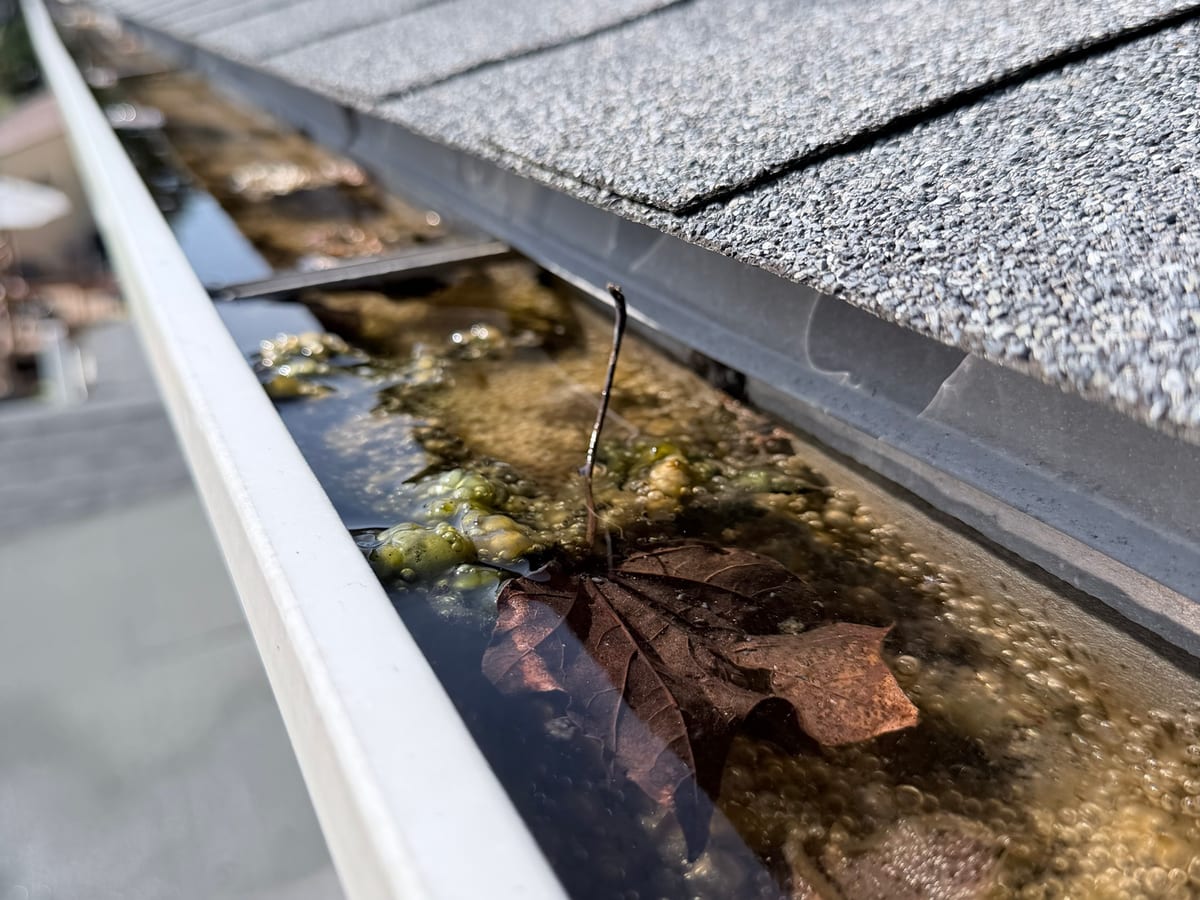
- Pull out loose debris first, so you test the gutter and not the leaves.
- Take the hose to the end of the run farthest from the downspout.
- Lay it in the gutter at a steady medium flow.
- Watch the water. If it pools, stalls, or runs backward instead of heading to the downspout, you have a pitch problem.
- Have your helper watch the downspout outlet at the ground. Water should come out within seconds at about the flow you put in.
- If water backs up at the gutter outlet, tap the downspout from the top down. A dull, solid sound marks where the clog is.
- If water comes out at the bottom but the downspout feeds a pipe in the ground, pull the downspout off that pipe and run the hose straight into the pipe. If it backs up, the clog is underground.
- Last, move the hose to each inside corner and seam. Watch for drips behind the gutter or water leaking at the corner joint.
Why do gutters overflow in heavy rain but not light rain?
Every gutter and downspout has a maximum flow. A hard summer thunderstorm can top it in minutes, even with clean gutters. If yours only overflow in big storms, suspect size, downspouts, or a roof valley before a clog.
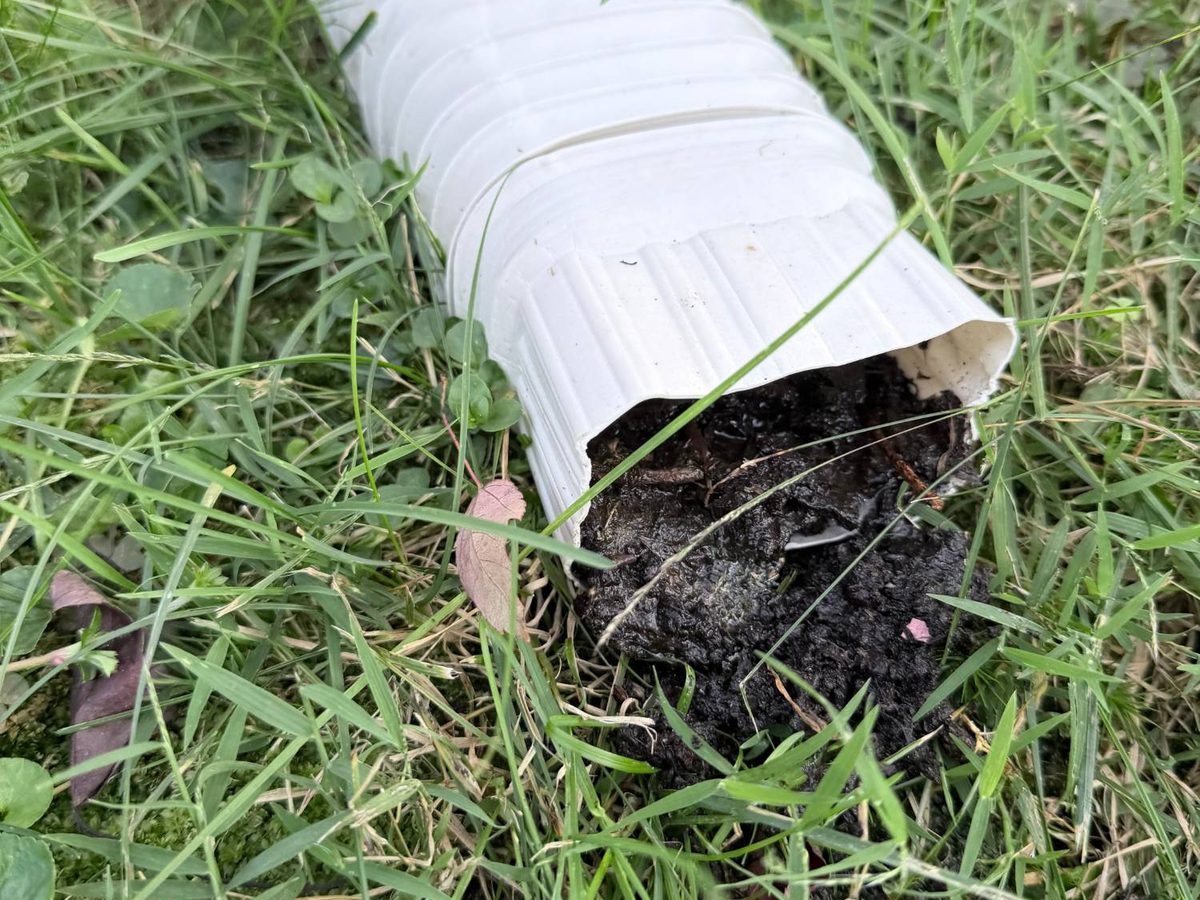
Overflow in a light rain is a different problem. On cleanings in Canton, Massillon and North Canton in September 2026, one cause kept coming up, and it was not the gutter. It was the top elbow, the bend where the downspout leaves the gutter, packed solid with wet gunk. With that elbow plugged, the run above it fills like a bathtub and spills over the front edge in even a light rain. Scooping the gutter does not fix it. The elbow has to be cleared and the downspout flushed until water runs fast out the bottom.

NOAA's precipitation frequency data for the Akron-Canton airport area shows about 1 inch of rain in one hour happens about once a year on average, and about 1.75 inches in an hour about once every 10 years. For a few minutes at the peak of a storm, rain can fall at a rate of about 4.6 inches per hour in a storm expected about once every two years, and about 6.3 inches per hour in a 10-year storm. Gutters are sized for those short peaks.
10 causes of overflowing gutters and how to fix each
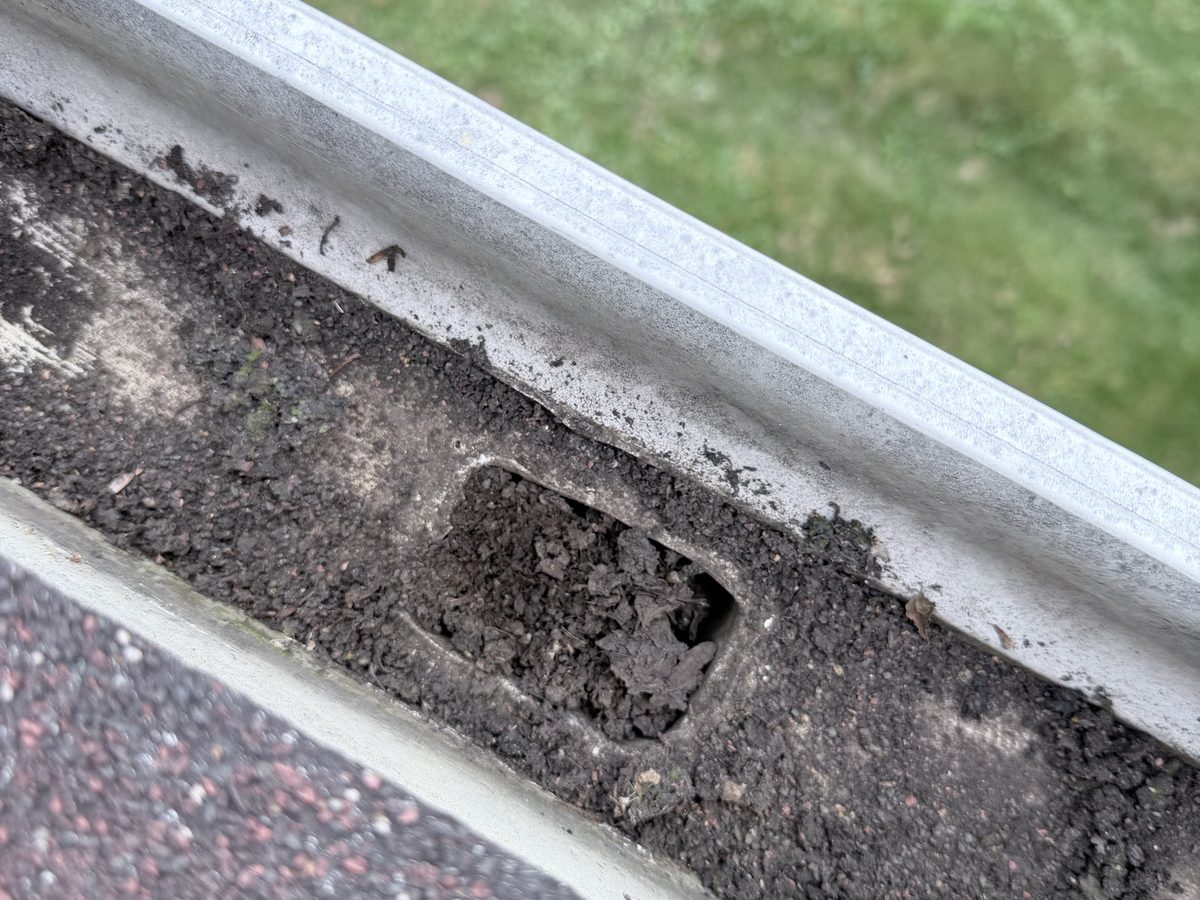
1. Clogged gutter
How to spot it: Seedlings growing out of the gutter, a gutter bowing under its own weight, or dirty streaks down the outside face. From a ladder you see a packed mat of leaves, seeds, or needles.
DIY fix: Scoop the gutter by hand into a bucket, then flush it with a hose toward the downspout. In Northeast Ohio the two big loads are maple seeds in late spring and oak and maple leaves in October and November. Our guide on how often to clean gutters in Ohio covers timing by tree type.
Call a pro when: The house is two stories, the roof is steep, or you are not steady on a ladder.
Rough cost: Professional gutter cleaning in Northeast Ohio commonly runs about $100 to $250 for a single-story and $150 to $350 for a two-story, a market range, not a Guttrz price. Guttrz prices a cleaning by stories, footage, how packed the gutters are, and whether guards are on, with a firm price from your address and a photo.
2. Clogged downspout or elbow
How to spot it: The gutter fills to the brim near the outlet while only a trickle comes out the bottom, and water may spray from the elbow seams. The bottom elbow is the most common spot for a clogged downspout. On our own jobs we keep finding the top elbow packed too, where the downspout leaves the gutter.
DIY fix: Remove the bottom elbow (usually two or three screws) and pull out what is packed inside. Then run a hose down from the top. For a stubborn clog, push a plumber's snake up from the bottom.
Call a pro when: The clog is high on a two-story downspout, or the downspout is crushed.
Rough cost: Clearing is often part of a cleaning visit, so ask. A replacement elbow costs a few dollars at a home store.
3. Underground drain clog
How to spot it: The downspout runs into a buried pipe, and in rain water bubbles out where they meet. Step 7 of the hose test confirms it.
DIY fix: Try a drain snake from the top of the buried pipe. As a stopgap, cut the downspout a few inches above the pipe, cap the pipe, and add an extension that carries water well away from the foundation.
Call a pro when: The snake will not get through. Roots or a collapsed section may be the cause, and a drain company can run a camera to find out.
Rough cost: National cost guides list drain jetting at a few hundred dollars on average. Digging up and replacing a broken line costs more.
4. Wrong pitch or a sagging section
How to spot it: Water still sits in the gutter a day after rain. From the ground, sight down the run: a low belly in the middle is easy to see. A gutter should drop about 1/4 inch for every 10 feet toward the downspout, so a 40-foot run should fall about 1 inch end to end. Loose spikes backing out of the fascia are a common reason it sags.
DIY fix: On a single-story run, replace loose spikes with hidden hangers screwed into the fascia about every 2 feet, lifting the low section as you go.
Call a pro when: The run is long, the fascia wood behind it is soft, or the gutter is pulling away from the house. Our post on gutters pulling away from the house covers that fix.
Rough cost: National cost guides put a simple pitch adjustment at about $75 to $200.
5. Gutters too small for the roof, or 5-inch on a steep roof
How to spot it: The gutter is clean and pitched right, but in hard rain water sheets over the whole front, worst below large, steep roof sections. Measure across the top to see if you have 5-inch or 6-inch.
The math: A common sizing rule rates a 5-inch K-style gutter for about 5,520 square feet of roof at 1 inch of rain per hour, and a 6-inch for about 7,960. Divide by the local peak rate. Example: a 50-foot gutter under a roof that runs 16 feet back to the ridge, measured level, drains 800 square feet. A steep 9/12 pitch adds about 20%, so 960. At about 4.6 inches per hour, a 5-inch gutter handles about 1,200 square feet and keeps up. In a 10-year storm at about 6.3 inches per hour, its limit drops to about 875 and it overflows. A 6-inch gutter handles about 1,260.
DIY fix: Not really a DIY job, though adding a downspout (cause 6) or a splash guard (cause 7) reduces the load.
Call a pro when: Overflow happens in ordinary summer storms on a clean, well-pitched gutter.
Rough cost: National cost guides commonly list new seamless aluminum gutters at about $6 to $20 per foot installed. Often only one side needs it.
6. Too few downspouts, or downspouts too small
How to spot it: Water piles up and spills at the end of the run away from the downspout, or right at the outlet in heavy rain. Look for one downspout serving a long run, or a small 2x3-inch downspout under a big roof.
The rule of thumb: A 2x3-inch downspout is rated for about 600 square feet of roof, and a 3x4-inch for about 1,200. Runs of 60 feet or longer should have at least two downspouts. In the example above, 960 square feet on a single 2x3 downspout is too much. It needs a second 2x3 or one 3x4.
DIY fix: Cutting in and sealing a new outlet is doable on a single-story home if you are handy.
Call a pro when: The run is two stories up or you want to switch to larger 3x4 downspouts.
Rough cost: Cost guides put adding a basic downspout to an existing gutter at roughly $75 to $250.
7. Roof valley dumping water past the gutter at a corner
How to spot it: The gutter overflowing at a corner, usually an inside corner where two roof slopes meet, is the classic sign. Water rushes down the valley and shoots over the gutter, leaving a dug-out trench in the mulch below. Inside corners also collect debris, so rule out a clog first.
DIY fix: Install a valley splash guard, a small bent piece of metal fastened to the outer lip of the gutter at the corner. It catches the rush and turns it back into the gutter.
Call a pro when: The corner is two stories up or its seam leaks.
Rough cost: The splash guard part is inexpensive. If a pro installs it, expect a small service call.
8. Gutter installed too low or a drip edge gap
How to spot it: This is the main cause of a gutter overflowing but not clogged at all. Water runs behind the gutter instead of into it, leaving drips against the house and stained or peeling fascia. From a ladder, check that the shingle edge and drip edge reach out over the gutter. If you can see down through a gap, water can follow the roof edge and miss the gutter.
DIY fix: Limited. A gutter hung too low has to be rehung without losing pitch.
Call a pro when: You find the gap. A roofer or gutter installer can add gutter apron flashing that bridges from under the shingle edge into the gutter.
Rough cost: The flashing is cheap. You mostly pay for labor.
9. Clogged or wrong type of gutter guard
How to spot it: If your gutters are overflowing with gutter guards on, watch them in rain. Water running across the guard and off the edge means the surface is blocked. Sprouting foam inserts, needle-packed brush inserts, and reverse-curve hoods that overshoot in downpours all do this. Even good micro-mesh can get a film of spring pollen or shingle grit.
DIY fix: Brush or hose off the top of micro-mesh from a ladder. Pull foam or brush inserts out, clean them, and consider whether they are worth putting back.
Call a pro when: The guards are damaged or the wrong type for your trees. Our post on common gutter guard problems goes deeper.
Rough cost: A rinse is usually part of a cleaning visit. Stainless steel micro-mesh from Guttrz is priced per linear foot, one rate for single-story runs and a higher rate for two-story or steep roofs, corners included, with the cleaning included in the install. See the full gutter guard cost breakdown.
10. Ice in the gutter or downspout
How to spot it: A sunny winter afternoon melts snow on the roof, but the gutter and downspout are frozen solid. Meltwater spills over as icicles or backs up under shingles as an ice dam. Northeast Ohio's freeze and thaw swings make this a winter regular.
DIY fix: Clean gutters and downspouts before the first hard freeze and keep downspout outlets clear of snow piles. Do not chip ice out of gutters, which damages them and the shingles.
Call a pro when: Ice dams come back every winter. The lasting fix is usually attic air sealing and insulation, and our post on gutter guards and ice dams in Ohio explains why.
Rough cost: A late-fall cleaning is priced by stories, footage, and how packed the gutters are, with a firm price from your address and a photo. Attic work needs an on-site quote.
How to fix overflowing gutters: what to do first
Work from cheapest to most expensive. The cheap causes are also the most common.
- Clean the gutters and clear every downspout and bottom elbow.
- Run the hose test to check pitch, downspout flow, and underground drains.
- Fix sags and loose hangers, and add splash guards at valley corners.
- If a clean, well-pitched gutter still overflows in the next hard storm, add a downspout or upsize that run.
- Once the gutters drain right, decide whether guards make sense to keep them that way.
If you would rather have someone look, use the form on this page or text your address to (330) 818-5584. A cleaning, downspout flush, and corner reseal come free with any Guttrz guard install, and our how it works page shows the process from text to install day.
Common questions
Can overflowing gutters damage my roof?
They can. Water that backs up or runs behind the gutter soaks the fascia board and the edge of the roof deck, which leads to rot over time. In winter, a gutter full of ice makes ice dams more likely, and those can push meltwater under shingles. Catching overflow early keeps it a cleaning or small repair instead of a carpentry job.
Is it normal for gutters to overflow in heavy rain?
A little overflow at a valley corner in a rare, intense downpour can happen even on a good system. Overflow in ordinary storms is not normal. It means a clog, a pitch problem, or a gutter or downspout that is too small for the roof above it.
Can overflowing gutters cause basement leaks?
Yes. Water that spills over the gutter lands right against the foundation and soaks the soil there, which pushes water toward basement walls. Keeping gutters draining and having downspouts discharge well away from the house is one of the simplest ways to cut down on basement dampness.
Will bigger downspouts stop my gutters from overflowing?
They help when the gutter is clean and pitched right but cannot empty fast enough. A 3x4-inch downspout is rated for about twice the roof area of a 2x3-inch one. They will not fix a clog, a sag, or water shooting off a roof valley.
Why do my gutters overflow on only one side of the house?
Usually that side has a bigger or steeper roof section, a valley, more trees above it, or fewer downspouts. It can also be the side where the gutter has sagged. Run a hose test on that side and compare the roof area it drains to the other sides.
Can I drill holes in my gutter to stop it overflowing?
It is not a good idea. Holes dump water right next to the foundation, which is what gutters are meant to prevent, and they start rust and leaks. If a gutter needs more drainage, add a proper downspout outlet instead.
How often should I clean gutters to prevent overflow?
Most Northeast Ohio homes with nearby trees need cleaning twice a year, once in late spring after maple seeds drop and once in late fall after the leaves are down. Homes under heavy tree cover or pines may need a third cleaning. Homes with no trees nearby can often get by with one.
Keep reading
Written by Christian Schaffner, owner of Guttrz. Updated October 8, 2026.
Where we install
Get your quote
Six quick steps. We send you a price range within the hour.