Guttrz / Blog / Gutters and wet basements
Can clogged gutters cause a wet basement?
Found water in the basement after a storm? Here is how to tell if your gutters are to blame, what to check today, and what each fix costs.
Yes. Overflowing gutters and downspouts that empty within a few feet of the wall are among the most common and cheapest-to-fix causes of a wet basement. Each inch of rain on 1,000 square feet of roof makes about 623 gallons, and a single downspout can carry hundreds of gallons of that to one spot against your wall. Clean the gutters and extend downspouts 6 to 10 feet first. If water still comes in, or it rises through the floor, the cause is likely groundwater, drain tile, or cracks, and a waterproofing company is the right call.
Can clogged gutters cause a wet basement?
Clogged gutters can cause a wet basement, and so can downspouts that let water out right at the wall. Water pooling around the foundation soaks the soil and finds its way in through cracks, the floor joint, and window wells. That makes a clogged gutter basement leak one of the first things to rule out when you find water in the basement after heavy rain. It is not the only possibility, though.
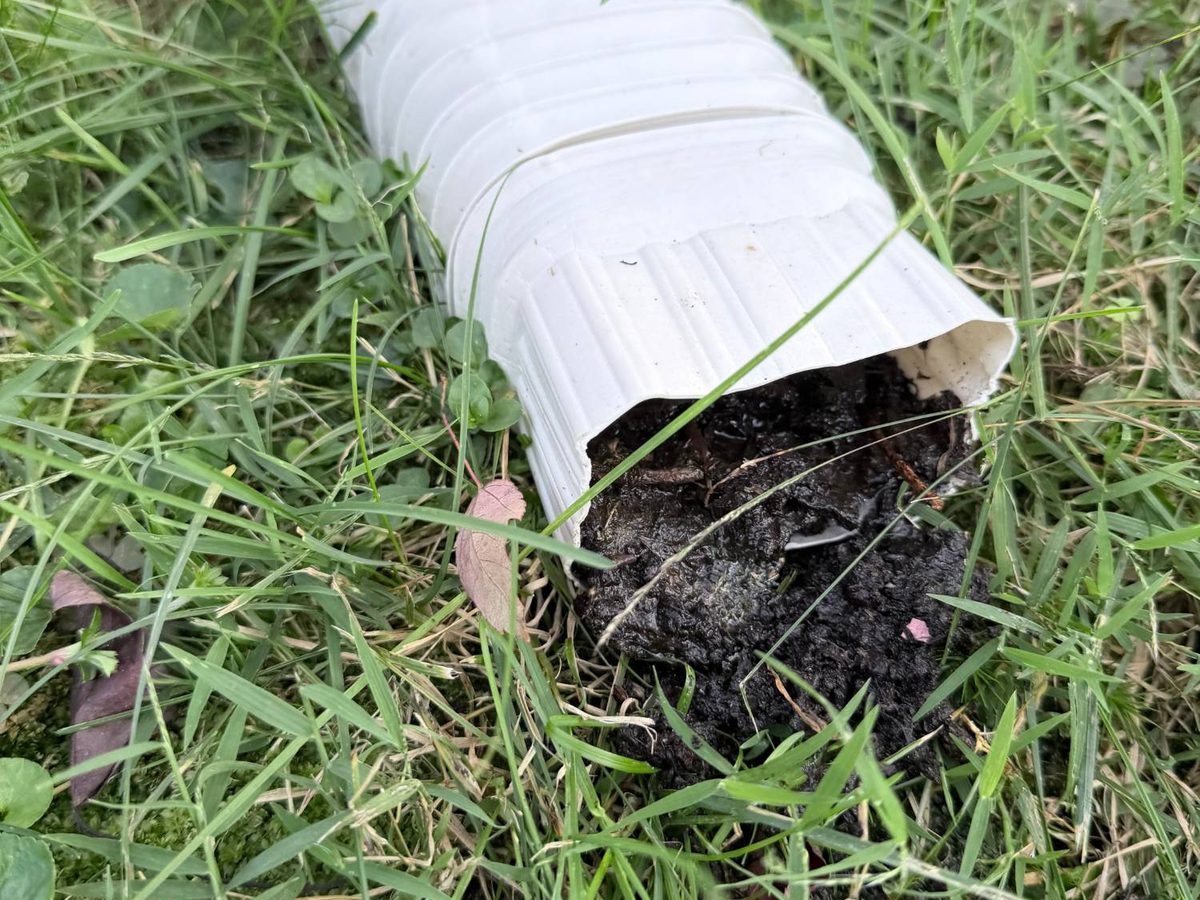
The University of Minnesota Extension lists the main sources of basement water as poor grading, defective gutters and downspouts, badly built window wells, failed drain tile, and structural cracks. Add a high water table and a sump pump that quit during the storm, and you have the full list. Gutters are where you start because they are the easiest to check and the cheapest to rule out.
How much water does your roof send toward your basement?
Every inch of rain on 1,000 square feet of roof makes about 623 gallons of water. That comes from simple math: a cubic foot holds about 7.48 gallons, so one inch of water over one square foot is about 0.623 gallons. Your gutters deliver all of it to a few downspouts.
Worked example: Say your house is 40 by 50 feet including the overhangs. That is 2,000 square feet of roof footprint. Use the footprint, not the sloped shingle area, because rain falls straight down.
- A 1-inch rain: 2,000 x 0.623 = about 1,246 gallons off the roof.
- With four downspouts sharing it evenly, each one carries about 310 gallons.
- If one downspout ends at the wall, that is more than five full 55-gallon drums poured into a few square feet of soil against your foundation.
- A 2-inch storm doubles it to about 620 gallons at that one spot.
A clogged gutter is similar. The water that should reach the downspout sheets over the front edge along 10 to 20 feet of wall instead. The soil below that stretch gets soaked from the top down, right where the basement wall is. That is how gutters and foundation damage end up linked: years of wet soil against one wall.
Why do Northeast Ohio basements get wet so easily?
Most homes here have basements, and many sit in soil that drains slowly. Water that lands next to the house tends to stay there, so gutter and downspout mistakes show up inside faster than they would in sandy ground.
Glacial till and clay-rich soils drain slowly
Much of Summit, Stark, and Medina counties sits on soils formed in glacial till. USDA soil descriptions for common Northeast Ohio till soils, such as the Wadsworth series and Ravenna series, rate them somewhat poorly drained with a dense layer called a fragipan that water moves through slowly. In undisturbed ground they can hold a perched water table within about a foot of the surface from October to June in a normal year.
Backfill around the foundation acts like a sponge
The hole dug for your basement was filled back in with loose soil. That backfill soaks up water faster than the dense ground around it can drain it, so water collects in that ring and presses on the wall. Backfill also settles over the years, so a yard that once sloped away can end up tilted toward the house.
Freeze-thaw and snowmelt pile on
In late winter, snow melts while the ground is still frozen. The water cannot soak in, so it runs to the lowest spot, often a settled strip by the foundation. Frost also shifts splash blocks and extensions, and a frozen downspout spills over its top.
Is it your gutters? A detective checklist for today
Do this on the day you find water, and again during the next rain. The goal is to match the wet spot inside to a water source outside. Gutter problems leave clues on the house and ground right next to the leak. Groundwater problems usually do not.
- Mark the wet spot inside. Note the wall, how far from the corner, and whether water is high on the wall, at the floor edge, or coming up through the middle of the floor.
- Go outside to the same spot. Pace off the distance from the corner so you are standing on the other side of that wall.
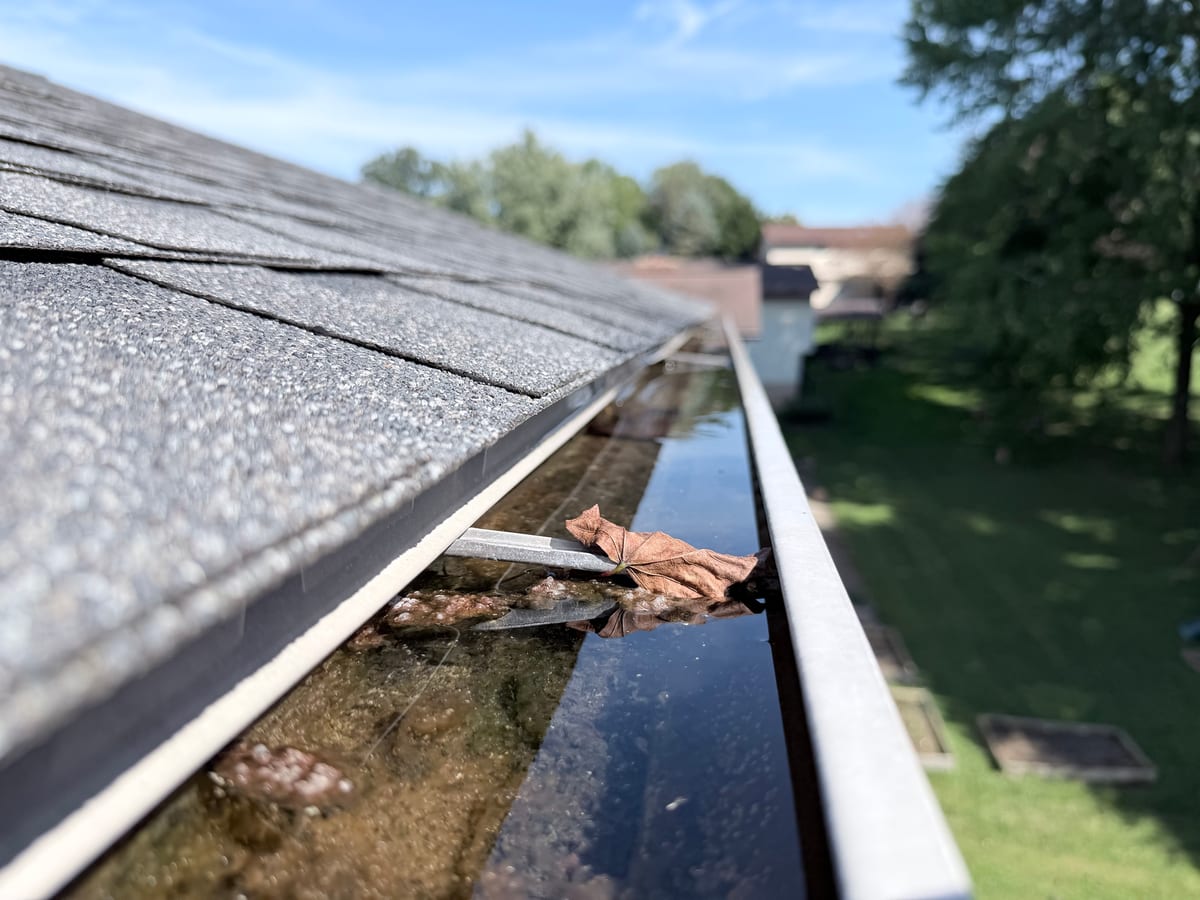
- Look up. Is there a downspout, an inside corner, or a roof valley right above? Is the gutter sagging or tilted away from the downspout?
- Look at the ground. Check for yard erosion from gutters: a small trench dug by falling water, bare soil, mulch washed away, or a pool that stays after the rain stops.
- Look at the siding and foundation. A band of mud or dirt splashed up the wall, called a splash line, means water has been hitting the ground hard right there.
- Follow each downspout to its end. Measure how far it lets water out from the wall. Under 4 feet is a suspect. Check that the extension is still attached.
- Check any downspout that goes into a pipe in the ground. Pull it off and run a hose into the pipe. If water backs up, that buried line is clogged and may be leaking against your footing.
- Check the inside wall for white, chalky crust. That is efflorescence, salt left behind as water moves through concrete or block. It marks where water has been coming in over time.
- Watch a real rain, or run a hose. In a storm, see where water spills and lands. On a dry day, run a hose at the high end of the gutter run above the wet spot for 20 to 30 minutes, then check inside. If the wet spot comes back, you found it.
If the wet spot sits right under a downspout or overflow point, gutters are the likely cause. If water comes through the middle of the floor, along every wall at once, or days after the rain stopped, it is probably groundwater, and gutters alone will not fix it. For more on reading overflow, see our guide to why gutters overflow.
What does your wet basement symptom point to?
| What you see | Most likely cause | First thing to try |
|---|---|---|
| Wet spot on the wall right under a downspout outside | Short or missing downspout extension | Extend it 6 to 10 feet |
| Damp stretch of wall under an overflowing gutter | Clogged gutter or a sag | Clean, flush, check pitch |
| Water at the window, puddle in the window well | Window well filling up | Cover, clear the well drain |
| Water only in hard storms, gutters clean | Too few downspouts, roof valley overload | Add a downspout or splash guard |
| Wet spot near a buried downspout pipe | Clogged or broken underground drain | Hose test the pipe, reroute above ground |
| Water seeping through a wall crack | Crack plus saturated soil | Fix drainage, then have the crack looked at |
| Water along the floor edge on several walls | High water table, failed drain tile | Call a waterproofing company |
| Water coming up through the floor or a floor drain | Groundwater pressure or sewer backup | Call a waterproofing company or plumber |
| Standing water around the sump, pump silent | Sump pump failure or power loss | Check the pump and float, add a backup |
| Walls damp in humid summer weather, no rain | Condensation, not a leak | Run a dehumidifier |
How to fix gutter-related basement water, and what it costs
Work from the top down. The first few fixes cost little and often solve the problem. Costs are typical market ranges from national cost guides and home center prices, not quotes.
Clean and flush the gutters and downspouts
Clear every gutter, then flush each downspout until water runs out the bottom freely. Clogs hide in the bottom elbow. Professional gutter cleaning in Northeast Ohio commonly runs about $100 to $250 for a single-story and $150 to $350 for a two-story, a market range, not a Guttrz price. Our post on how often to clean gutters in Ohio lays out the timing around spring seeds and fall leaves.
Add downspout extensions: how far should downspouts extend from the house?
University of Minnesota Extension says extensions should let water out at least 4 feet beyond the wall. University of Maryland Extension goes further and recommends 10 feet for homes with basements. With slow-draining Northeast Ohio soil, aim for 6 to 10 feet and make sure the water ends up on ground that slopes away. Vinyl, flexible, or aluminum extensions usually cost about $10 to $40 each in parts.
Use splash blocks where extensions are not practical
A splash block spreads water out and keeps it from digging a hole. On its own it only moves water about 2 feet, so use it at the end of an extension or where the ground falls away sharply. Expect about $7 to $25 each.
Consider underground downspout drains, with care
A buried pipe carries water to a pop-up emitter in the yard. Typical installed prices run about $150 to $350 per downspout for a simple run, and $1,500 to $7,000 for a whole-house system. The catch is clogs. Leaves and shingle grit wash in, the pipe fills, and water leaks at the footing where you cannot see it.
Regrade the soil to slope away
The International Residential Code section R401.3, the model for Ohio's residential code, calls for ground to fall at least 6 inches within the first 10 feet from the foundation. Lay a 10-foot board on the ground with a level on it and measure the drop. Adding and packing soil along one side of a house typically costs $500 to $1,000, and $1,000 to $3,000 for the whole house.
Cover window wells
A window well under a gutter run can fill like a bucket. A clear cover keeps roof runoff out. Basic plastic covers run about $70 to $200 installed, and custom or heavy-duty covers $250 or more.
Reslope sagging or flat gutters
A flat or back-pitched run holds water and spills it in one spot. Re-hanging a run to the right pitch typically costs about $85 to $250. If the gutter is pulling off the fascia, read what to do when gutters pull away from the house first.
Add a downspout
University of Minnesota Extension suggests at least one downspout per 50 feet of eave. Aluminum downspouts typically cost about $7 to $30 per foot installed, which works out to roughly $150 to $400 for a new one on most houses.
Add gutter guards so it does not happen again
Once the gutters drain right, guards keep leaves and maple seeds from clogging them before the next storm. Guttrz installs stainless steel micro-mesh guards priced per linear foot, one rate for a single story and a higher rate for two-story or steep roofs, corners included, and the cleaning, downspout flush, and corner reseal are included. Small fixes during the install, like a missing downspout section, a loose hanger, or a leaking seam, are included at no charge. Price follows footage, so a 250-foot colonial costs more than a 140-foot ranch, and you get one firm written price after the 20-minute on-site check, good for one year. Our post on whether gutter guards are worth it covers who should skip them.
Where are you allowed to send downspout water in Northeast Ohio?
Local rules apply to where roof water goes. Summit County's Department of Sanitary Sewer Services treats a downspout tied into the sanitary sewer as an illicit connection. If your downspout goes into a pipe and you are not sure where that pipe leads, ask your city or county sewer department before you change anything.
Many communities also limit sending water onto a neighbor's property or across a public sidewalk, where it can freeze. Rules differ by city and township, so check with your local building or engineering department before a big reroute or a buried drain.
When should you call a basement waterproofing company instead?
Call a basement waterproofing company when water keeps coming in after the roof water is handled, or when the signs point below ground. Gutters and extensions control water from above. They cannot lower a high water table, repair failed drain tile, or fix a moving wall. Watch for any of these:
- Water still comes in after gutters are clean and downspouts reach 6 to 10 feet out.
- Water rises through the floor or the joint where the floor meets the wall on several sides.
- Walls are bowing, bulging, or have horizontal cracks, or cracks are getting wider.
- The basement gets wet days after the rain ends, or during snowmelt with no rain.
- Your sump pump runs constantly or has failed.
Typical market ranges from national cost guides: crack injection often runs about $800 to $1,500 per crack, a sump pump $1,200 to $2,500 installed, and an interior drain tile system with a sump often $4,000 to $8,000. Guttrz does not do waterproofing, grading, or underground drains. We fix the roof water side.
What should you do next?
Clean the gutters, extend every downspout 6 to 10 feet, and watch the next rain. If the wet spot goes away, you are done for the cost of a cleaning and a few extensions. If you want a hand, Guttrz prices a cleaning from your address and a photo, usually within the hour during business hours, and our 20-minute on-site check includes downspout placement and gutter pitch. Use the form on this page, text (330) 818-5584, or see full gutter guard pricing.
Common questions
Do gutter guards stop basement leaks?
Gutter guards stop leaks caused by clogged, overflowing gutters. They do not fix short downspouts, bad grading, cracks, or groundwater. Think of guards as the step that keeps a fixed drainage system working, after downspouts reach 6 to 10 feet out and the soil slopes away.
Can a downspout cause foundation cracks?
It can add to them. A downspout that empties at the wall keeps the soil there saturated, and wet soil pushes harder on basement walls, especially clay-rich soil in freeze-thaw weather. Water then finds existing cracks and can make them worse. Moving the water 6 to 10 feet away removes that extra load, but a crack that keeps growing should be looked at by a foundation or waterproofing pro.
Is it OK for a downspout to drain onto the driveway?
It can be, if the driveway slopes away from the house and the water does not pool at the garage or run onto a sidewalk. The downside in Ohio is winter, when that water freezes into a sheet of ice. Check that the path of the water is safe before you rely on it.
Should I bury my downspouts?
Only if you are ready to keep them clear. Buried downspout drains look clean, but they clog with leaves and shingle grit, and a clogged pipe can leak right at the footing. Above-ground extensions are cheaper and easy to check. If you bury them, use smooth-wall pipe, a clean-out, and a pop-up emitter well away from the house, and keep the gutters clean.
Why does my basement only leak in heavy rain?
In light rain, gutters, downspouts, and soil keep up. In a hard storm, a partly clogged gutter or a long run with one downspout overflows, and slow-draining soil next to the house saturates fast. If the leak lines up with a gutter spot, fix that first. If it does not, heavy rain may be raising groundwater under the floor.
Can a wet basement from gutters cause mold?
It can. Mold needs moisture, and a wall or carpet that gets soaked every storm gives it plenty. The EPA advises drying water-damaged areas and items within 24 to 48 hours to help prevent mold growth. Use fans and a dehumidifier right away, and fix the water source so it does not keep coming back.
Can I just seal my basement walls from the inside?
Interior sealer paint can cut down on dampness from minor moisture, but it does not stop water pushed in by saturated soil. If the source is a gutter or downspout, fix that first, because sealing the inside while water keeps pouring down the outside rarely lasts. For active leaks, get a waterproofing company's opinion.
How long does it take for the basement to dry after fixing the gutters?
The wet spot inside often dries within days to a couple of weeks once water stops reaching it, faster with a fan and a dehumidifier. Clay-rich soil outside can stay wet longer. Watch the next two or three rains. If the spot stays dry, the gutter fix worked.
Keep reading
Written by Christian Schaffner, owner of Guttrz. Updated October 8, 2026.
Where we install
Get your quote
Six quick steps. We send you a price range within the hour.