Guttrz / Blog / Repair or replace gutters
Repair or replace gutters: how to tell which one you need
Most gutter problems are repairable. Here is how to tell a reseal or a rehang from a gutter that is truly done.
Most gutter problems are repairable. One leaking corner, a sagging run with sound metal, loose spikes on straight aluminum, and a clogged downspout are all repairs. Replace gutters when you see rust-through, seams split along their length, crushed sections, a sag that returns after a proper rehang, many leaking joints on sectional gutter, or gutters too small for the roof. Aluminum gutters commonly last 20 years or more. New seamless gutters in Northeast Ohio are commonly quoted at about $8 to $14 per foot for 5-inch, a market range and not a Guttrz price.
Repair or replace gutters: the honest answer is that most gutter problems are repairable. A drip at a corner, a run that sags, a gutter tipping off the house, and a downspout that backs up are all fixes, not reasons to buy new gutters. Replacement is the right call when the metal itself has failed, when the gutter is too small for the roof, or when the same repair keeps failing. This guide gives you a symptom-by-symptom table, the truth about gutter age, a plain cost comparison, and a checklist you can run from the ground and from a ladder. Guttrz does both repairs and replacements, so we have no reason to push you either way.
Should you repair or replace gutters? A symptom-by-symptom table
Repair when the problem is a joint, a slope, a fastener, or a clog. Replace when the gutter body is rusted through, split, crushed, or undersized. Find what you see in the left column. The right column is the usual answer, assuming the rest of the gutter is sound.
| Symptom | Likely cause | Repair or replace |
|---|---|---|
| Drip at one corner or end cap | Cracked sealant in the joint | Repair. Scrape and reseal. |
| Water sits in the gutter a day after rain | Run has lost its slope, or the outlet is blocked | Repair. Clean, then reslope if it still holds water. |
| One run sags or dips in the middle | Hangers or spikes have let go | Repair. Rehang on hidden hangers, if the metal is straight. |
| Gutter tips forward, gap at the fascia | Spikes backing out of the wood | Repair, unless the fascia is rotted. Then fix the wood first. |
| Overflow at the downspout end | Clogged outlet, elbow, or downspout | Repair. Flush it. |
| Overflow in heavy storms with clean gutters | Gutter or downspouts too small for that roof area | Replace that run with a larger size, or add a downspout. |
| Rust spots, pinholes, or rust-through | Steel gutter at the end of its life | Replace. |
| Seam split along its length | Metal fatigue or ice damage | Replace the run. |
| Crushed, kinked, or bent section | Ladder, limb, or ice | Replace the run. |
| Leaks at many joints on 10-foot sections | Sectional gutter with failing seams | Replace. Resealing every joint buys a season or two. |
| Sag returns after a proper rehang | Bent gutter or soft fascia | Replace, after the wood is checked. |
| Peeling paint or dark stains on the fascia | Water running behind the gutter | Check the wood. Often a repair plus a fascia fix. |
Notice how many rows say repair. If your problem is in the top five rows, start with our gutter repair page. If it is rust, splits, or crushed metal, look at seamless gutter replacement in Canton.
How long do gutters last, and are yours too old?
Age alone is not a reason to replace gutters. Aluminum does not rust, and a well-hung aluminum gutter commonly lasts 20 years or more. Steel gutters do rust, and once rust shows through the paint the gutter is on borrowed time. Look at the metal and the fasteners, not the calendar.
Aluminum or steel: how to tell
Hold a magnet to the gutter. If it sticks, the gutter is steel. If it does not, it is aluminum, or far less often copper or vinyl. You can also look for the giveaway: orange or brown rust stains, flaking, or pinholes along the bottom. Aluminum goes chalky white when it weathers. It does not turn orange.
Old galvanized steel gutters with rust on the bottom are a replace. Sealant and patches will not hold on metal that is flaking. An aluminum gutter of the same age that is straight and dent-free is usually worth keeping.
Spike-hung gutters on 1950s to 1980s homes
Many homes in Canton, North Canton, and Massillon were built in the 1950s to 1980s and still wear their original gutters. Those were hung with spikes and ferrules: a long smooth nail driven through the front of the gutter, through a metal tube, and into the fascia. You can spot them by the row of nail heads along the front edge.
Spikes back out over freeze-thaw cycles. From November to March the temperature here crosses freezing over and over, and each cycle works the nail loose a little more. Add a gutter full of ice and the run tips forward. That looks like a ruined gutter, but often it is only failed fasteners. If the aluminum is straight, the fix is to pull the spikes and rehang the run on hidden hangers that screw into the wood. Our post on gutters pulling away from the house walks through that repair.
The same era also left plenty of sectional gutters, sold in 10-foot pieces and joined every 10 feet. Each joint is a place that can leak or sag. One leaking joint is a repair. Joints leaking all along the house are a sign that it is time.
What do you check from the ground, and what from a ladder?
Ten minutes on the ground will sort most houses. A ladder check confirms it. If you are not steady on a ladder, skip that part. The 20-minute on-site check covers it.
From the ground
- Sight down each run. Stand at one end and look along the front lip. It should be straight with a slight fall toward the downspout. A dip is a hanger problem. A twist or kink is bent metal.
- Look for gaps. Daylight between the gutter and the fascia means the run has tipped forward.
- Look for stains. Orange streaks mean rust. Dark streaks or peeling paint on the fascia or soffit mean water is getting behind the gutter.
- Count the nail heads and the joints. A row of nail heads means spikes. A seam every 10 feet means sectional gutter.
- Watch in the rain. Note where water drips, where it sheets over the front, and whether each downspout runs strong at the bottom.
- Read the ground. Washed-out mulch or a trench in the soil marks the overflow spots.
From a ladder
- Look inside. Standing water, mud, or plants growing mean the run holds water. That is a clog or a slope problem, and both are repairs.
- Check the bottom of the trough. On steel, scrape a rusty spot with a screwdriver. If the tip goes through, the gutter is done.
- Check the corners and end caps. Cracked, hard sealant can be scraped out and redone.
- Wiggle the hangers. Push up on the front lip. A sound run barely moves.
- Press the fascia. Push a screwdriver tip into the wood behind the gutter near the worst spot. If it sinks in, the wood is rotted.
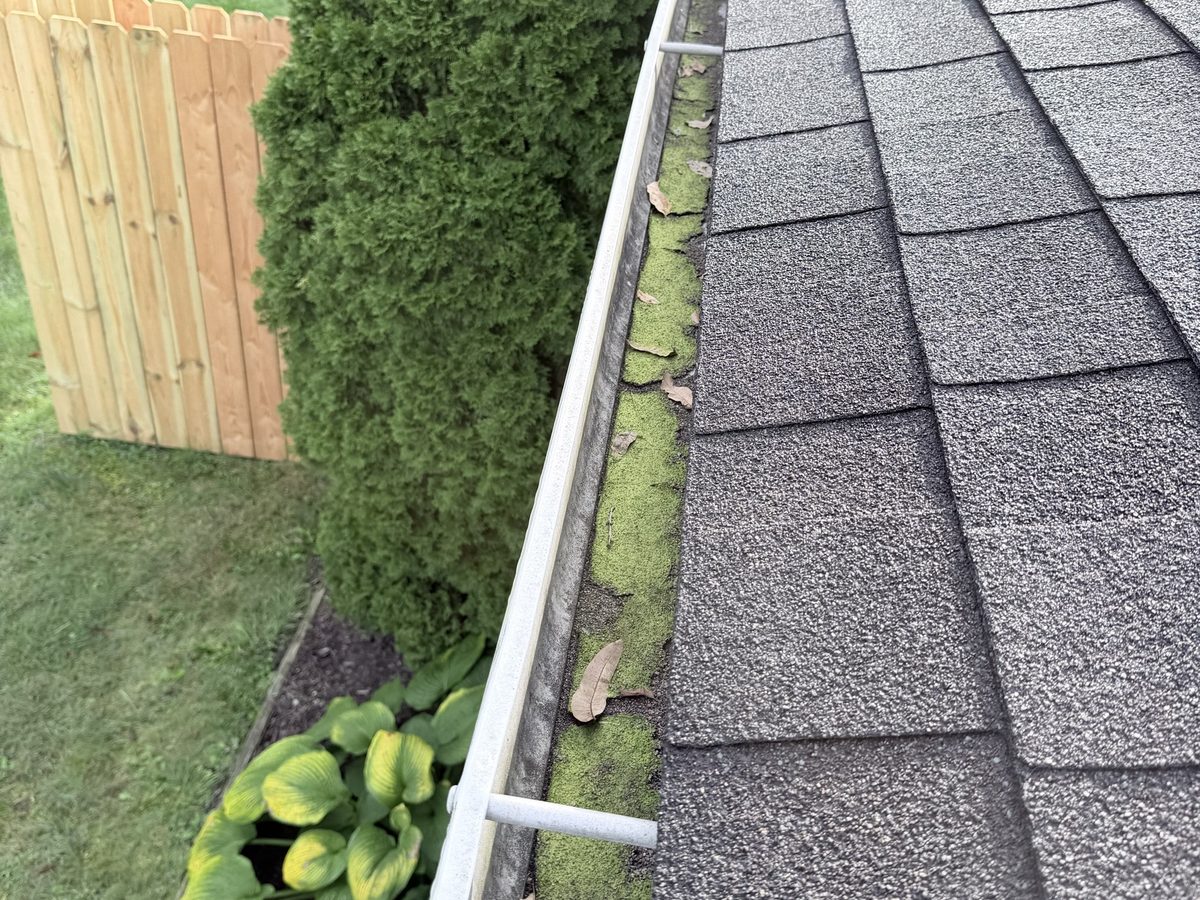
A gutter that is simply full will act broken. It overflows, it sags under the weight, and it leaks at corners that would be fine if water kept moving. Clean first, then judge. The signs you need a gutter cleaning are worth a look before you price anything bigger.
Gutter replacement vs repair cost: what do the numbers look like?
A repair usually costs a few hundred dollars. A replacement usually costs a few thousand. Seamless aluminum gutters in Northeast Ohio are commonly quoted at about $8 to $14 per foot installed for 5-inch and $10 to $18 per foot for 6-inch, so a typical 150 to 200 foot house commonly lands around $1,500 to $3,500.
Those replacement figures are market ranges, not Guttrz prices. Downspouts are usually a separate line, and some companies add about $1 to $2 per foot to remove the old gutters. For repairs, national cost guides put a typical gutter repair at roughly $195 to $625. That is a national range, also not a Guttrz price.
Here is what Guttrz actually publishes:
- Gutter cleaning: $150 to $300. Often the first and cheapest step, because a clean gutter shows you what is really wrong. Details are on the gutter cleaning page.
- Gutter repair: resealing corners, resloping a run, and rehanging on Boss J2 hidden hangers. There is no price list for repairs. You get one firm price at the on-site check, because the same drip can be a quick reseal or a rotted corner board.
- Repairs with a guard install: cleaning, corner resealing, and small fixes are included when you buy gutter guards at $17 per foot single story or $19 per foot two story, with a $1,200 minimum. See the gutter guard cost page.
- Gutter replacement: Guttrz does not publish a per-foot gutter price. Your firm price comes in writing after the on-site check and is good for one year. Tear-off and haul-away of the old gutters is included.
A simple way to decide on cost
Take a 160-foot house. At the commonly quoted 5-inch range, new gutters work out to about $1,280 to $2,240 before downspouts. If the house needs one corner resealed and one run rehung, a repair at a fraction of that is the clear choice. If it needs every joint resealed, three runs rehung, and two bent sections swapped, the repair bill starts to approach the low end of replacement, and the old gutter is still old. A rough rule: when the repairs you need this year add up to half the cost of new gutters, and the metal is tired, replace. For how replacement quotes are built, see seamless gutter cost in Ohio.
When is the fascia the real problem?
The fascia is the board the gutter hangs on. If that wood is rotted, no gutter will stay up, old or new. A hanger screwed into soft wood strips out the same way the old spike did. Many gutters that keep sagging are fine. The board behind them is not.
Signs the fascia is the problem:
- The gutter was rehung and pulled loose again within a year or two.
- Paint on the fascia is peeling or the wood is dark, especially at corners, below roof valleys, and beside downspout outlets.
- A screwdriver tip sinks into the wood.
- The soffit below is stained or sagging.
Rot can hide under aluminum fascia wrap, so a board can look clean and still be soft. The usual cause is water running behind the gutter for years, often because the gutter tipped forward or overflowed at the back. That same water is headed for your foundation, which is the link between clogged gutters and a wet basement.
The order matters: fix the wood first, then hang the gutter. If the gutter is sound it can go back up on the new board. If it is not, this is the natural time to replace it, since it has to come down anyway. On a Guttrz gutter replacement, the fascia is checked once the old gutter is off. Rotted wood is a separate repair, and it is quoted before work continues.
What are the signs you need new gutters and not another repair?
You need new gutters when one or more of these is true:
- Rust holes or rust-through on steel gutters.
- Seams split along their length.
- Sections crushed, kinked, or bent out of shape.
- A sag that returns after a proper rehang on sound wood.
- Many leaking joints on sectional gutter.
- Clean gutters that still overflow in summer thunderstorms, because they are too small for the roof.
- The fascia behind them is being replaced anyway.
The size problem deserves a note. A 6-inch gutter carries roughly 40 percent more water than a 5-inch, and its 3x4-inch downspout moves roughly twice the water of a 2x3. If one valley floods one corner in every storm, replacing only that run with the larger size can solve it. The comparison is in 5-inch vs 6-inch gutters.
If none of the items on that list fit, you most likely need a repair or a cleaning, and you should be wary of anyone who says otherwise without getting on a ladder.
What to do next
Run the ground check, find your symptom in the table, and take a photo of the worst spot. If you want a second set of eyes, Guttrz does a 20-minute on-site check with a ladder and tells you plainly which it is. A repair gets a firm repair price. A replacement gets a written price for new seamless gutters, good for one year, with no in-home sales presentation. The steps are on our how it works page. Use the form on this page or text your address and the photo to (330) 818-5584.
Common questions
When should gutters be replaced?
Replace gutters when the metal has failed or the size is wrong. That means rust holes, seams split along their length, crushed or bent sections, sags that come back after a proper rehang, or sectional gutters leaking at many joints. Gutters that overflow in heavy rain while clean may be too small for the roof. Age by itself is not a reason.
Can you replace just one section of gutter?
Yes. If one run is crushed, split, or undersized and the rest are sound, only that run needs to be replaced. A new seamless piece is formed to the length of that run. The color of new and weathered aluminum may not match exactly, so ask about that on a run that faces the street.
Is it worth repairing 20-year-old or 30-year-old gutters?
Often, yes, if they are aluminum. Aluminum does not rust, so a 30-year-old gutter can be straight and sound while its spikes and sealant have failed. Rehanging on hidden hangers and resealing the corners can give it many more years. If the gutter is steel and showing rust, or the metal is bent and wavy, put the money toward replacement.
Do rusted gutters need to be replaced?
Surface rust on a steel gutter can be slowed, but rust that has made pinholes or flakes through the bottom cannot be repaired in a lasting way. Sealant does not bond to flaking metal. Once rust-through starts in one spot, the rest of the run is usually close behind. Replacement with aluminum ends the rust problem for good.
Will new gutters fix water in my basement?
Only if the gutters are the cause. Overflowing or leaking gutters dump roof water next to the foundation, and fixing that often dries a damp basement wall. But a repair or a cleaning may solve the same overflow for far less than new gutters. Also check that downspouts discharge several feet from the house and that the ground slopes away.
Should I replace gutters before installing gutter guards?
Only if the gutters are failing. A guard fastens to the gutter and cannot fix a sag, a leak, or rust under it, so the gutter has to be sound first. Most gutters need only a cleaning, a reseal, and a few hangers, which Guttrz includes with a guard install. If the gutters do need replacing, guards can go on the new gutters the same visit at the normal guard rate of $17 or $19 per foot.
Does homeowners insurance pay for new gutters?
It depends on the cause and your policy. Sudden damage from a covered event, such as a fallen limb or a storm, is often covered. Wear, rust, age, and lack of maintenance usually are not. Read your policy or ask your agent before you assume either way, and take photos of the damage before anything is repaired.
Does Guttrz repair gutters or only replace them?
Both. Guttrz reseals leaking corners, reslopes runs that hold water, and rehangs sagging gutters on Boss J2 hidden hangers. Guttrz also installs new 5-inch and 6-inch seamless aluminum gutters and downspouts. The 20-minute on-site check tells you which one your house needs, and you get one firm written price for that work.
Keep reading
Written by Christian Schaffner, owner of Guttrz. Updated October 4, 2026.
Where we install
Get your quote
Six quick steps. We send you a price range within the hour.